بِسْمِ اللّٰهِ الرَّحْمٰنِ الرَّحِيْمِ
“In the name of Allah the Most Gracious, the Most Merciful.”
Performing Tawaaf is fardh in Umrah.
1. In the state of wudhu, make an intention that you are performing tawaaf for ‘umrah. The intention does not need to be verbal nor is it necessary for it to be in Arabic, it can be done in one’s own language.
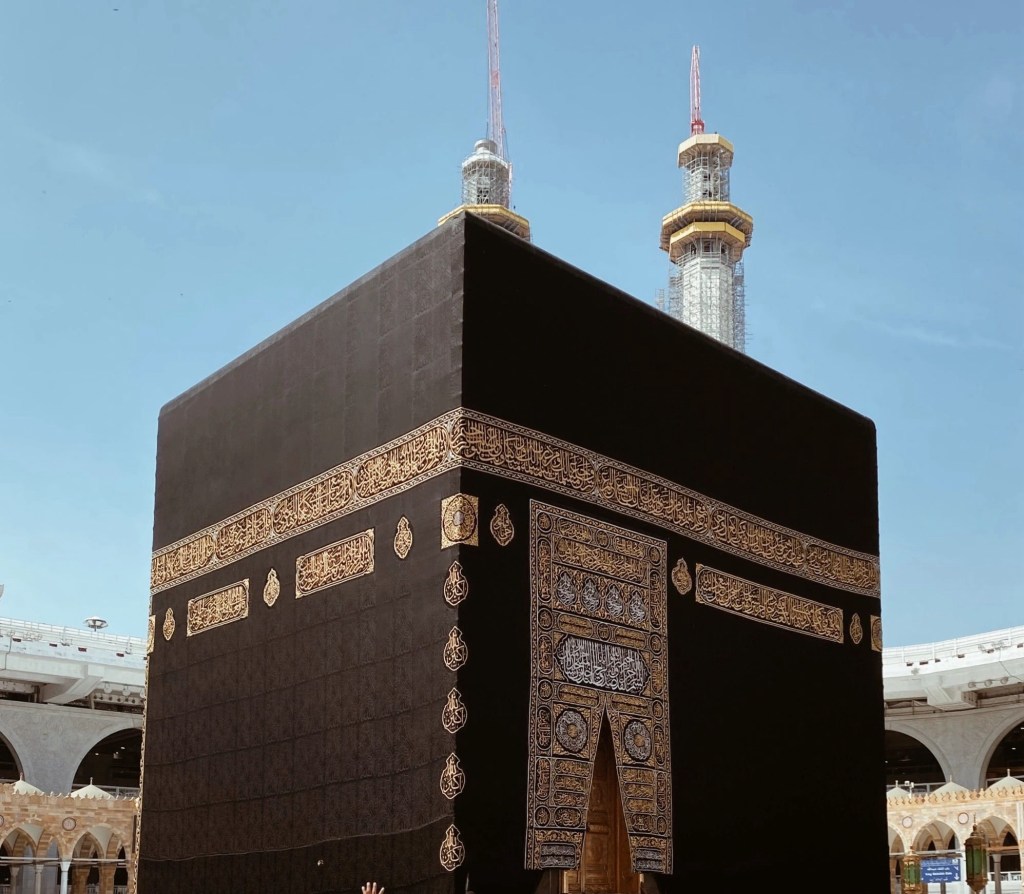
2. After making the intention, proceed towards the corner of the Ka’bah in which lies Al hajarul aswad (You will see a green light directly opposite in line with Al hajarul aswad).
• It is crucial that tawaaf begins & ends correctly & so one must commence tawaaf in line with Al Hajarul aswad, if it is started after passing Al Hajarul aswad, it will remain incomplete. Similarly, the 7th round must end in line with Al Hajarul aswad. If tawaaf is ended before reaching Al Hajarul aswad, it will remain incomplete.
3. Staying in line with the Hajar-al-Aswad, face the entire body towards the Hajar-al-Aswad and perform istiqbaal. This is to raise your hands as you do in salaah (shoulders for women and ear lobes for men) and say:
الله اَكْبَرْ لا اِلٰهَ الّا الله
Allaahu Akbar La ila ha ilallah
Or
بِسْمِ اللهِ اَللهُ اَكْبَرُ ولِلهِ الْحَمْد
“Bismillahi Allaahu Akbar wa lilahil hamd”
Istiqbaal will always be done before commencing tawaaf whether it is for ‘umrah or a nafl tawaaf.
4. Then put the hands back down and perform istilaam. This is to kiss the black stone without a smack. If kissing/touching is not possible (as is the case now due to the great number of people), raise both hands with the palms facing the Hajar-al-Aswad and say:
بِسْمِ اللهِ اَللهُ اَكْبَرُ
“Bismillahi Allaahu Akbar”
Then kiss the palms of the hands. Istilaam should also be performed at the end of every round, without turning the full body towards the Hajar-al-Aswad.
5. Now move towards the right, keeping the Ka’bah on your left and walk around Ka’bah (anti-clockwise) until you again estimate that you are in line with Al Hajarul Aswad. Stop, stand exactly where you are and do istilaam. You have now completed one round. You must complete seven rounds in this manner to complete the tawaaf. When stopping to do istilaam it should be a quick few seconds so it doesn’t cause any trouble to others performing tawaaf.
7. Then if possible, proceed to make du’aa at the Multazam. This is a section of Kaa’bah wall between the Hajarul Aswad and the door of Kaa’bah. If possible, cling to the wall with arms stretched above the head, placing your right and then left cheek on the Kaa’bah walls, and try to shed some tears. Du’aas are accepted here. If this is not possible which it usually isn’t, you may sit anywhere in the haram & make du’aa.
8.Thereafter face the kaa’bah & drink as much zamzam as one can.
Du’aa when drinking zam zam water:
اللَّهُمَّ إِنِّي أَسْأَلُكَ عِلْمَاً نَافِعَاً وَرِزْقَاً وَاسِعَاً وَشِفَاءً مِّنْ كُلِّ دَاءٍ
Allahumma inni as-aluka ilman nafian wa rizqan wasian wa shifaam-min kulli daain
“O Allah, I seek beneficial knowledge, wide sustenance and cure from all ailments from You”.
It is not permissible for a menstruating woman to enter the haram or perform tawaaf. She will complete her umrah after she has finished her menstruation & performed ghusl. Untill then she will remain in the state of ihraam.
Rulings Regarding Tawaaf
Ruling No 1: There are two conditions for Tawaf to be valid:
1. The person must be in the state of wudhu.
2. Intention of Tawaf must be made (either verbally or in the heart).
Ruling No 2: It is not permissible for a woman in her menses to perform Tawaaf.
Ruling No 2: Do not start Ṭawaaf when the time of Fardh Salaah is close.
Ruling No 3: Its Makhrooh-e-Tahrimi (close to Ḥaraam) to look at, face or turn one’s back towards the Ka’bah whilst performing Tawaf. Facing the Ka’bah is allowed only when facing the corner of Hajarul-Aswad and Rukn-e-Yamānī.
Ruling No 4: Whilst in Tawaaf, it is desirable for the person to look down at the place of Sajdah.
Ruling No 5: During Tawaaf make Dhikr and avoid discussion of worldly matters. Any Du’aa (in Arabic or one’s own language) may be made softly without the hands being raised, or you may also choose to remain quiet. It is not necessary to follow those du’aa books that contain certain du’aas for each circuit around the Kaa’bah. Reading the Qur’aan, glorifying Allaah and making du’aas from the heart is just as rewarding.
Ruling No 6 : It is permissible to walk in front of a person performing Salāh if one is in Ṭawaaf.
Ruling No 7 : Seven circuits will make one Tawaf complete.
Ruling No 8: If you are in the state of Iḥrām, you must not touch the Hajarul-Aswad, Rukn-e-Yamānī or any part of the Ka’bah due to the scent that is applied on them.
Ruling No 9: Care must be taken that the Ṭawaf is done away from the men at all times. An effort should be made to avoid mixing and walking side by side with men.
Ruling No 9: Upon approaching Rukn-e-Yamānī (the corner prior to that of Hajarul-Aswad), it is sunnah to recite:
رَبَّنَا أَتِنَا فِي الدُّنْيَا حَسَنَةً وَفِي الْآخِرَةِ حَسَنَةً وَقِنَا عَذَابَ النَّارِ
Rabbana atina fid-dunya hasanatan wa fil Aakhirati hasanataw – waqina ‘adhaban-naar
Ruling No 10 :During tawaaf when you come to Al Ruknul Yamaani, merely touch it with both hands or the right hand. It is not Sunnah to kiss or raise hands at this corner. If touching is not possible, do not make any gestures towards Rukn-e-Yamānī, continue to walk towards the line of Hajarul-Aswad.
Ruling No 11 : Upon arriving at the corner of Ḥajarul-Aswad, only turn the face to the left whilst keeping the feet towards the direction of Ṭawaaf & then do istilaam. Do not linger at the point where you are in line with the Ḥajarul-Aswad. Move on!
Ruling No 12: Hateem is part of Ka’bah. Therefore, one must go around the Hateem to complete the Tawaaf.
Ruling No 13: It is necessary to have the same amount of body covered in Tawaaf which is necessary to be covered in Salaah. Therefore care should be taken that the hair is properly covered.
Ruling No 14: It is necessary for the person who is capable of walking to walk during Tawaaf.
Ruling No 15: It is necessary for Tawaaf to be performed anti-clockwise.
Ruling 16: Tawaaf should be completed without any interruptions. However, if the Adhaan is called out whilst one is performingTawaaf, one should stop Tawaaf and join the salaah immediately. After salaah, carry on with Tawaaf from the point one stopped. One does not have to return to Ḥajarul-Aswad to restart the interrupted round.
Ruling 17: Make personal, private du’aas; do not do make du’aas as part of a group, shouting them as you go around.
 Tayyibah Tree
Leave a comment